Visitor Management: New Features to Streamline Your Checkin Flows
Over the past few months, we've been fairly quiet about product updates.
No big announcements. Yet Anghello has evolved significantly. With practical improvements driven directly by customer feedback from the field. Some are already in use. Here's the full rundown.
🔔 Microsoft Teams Notifications
Streamline arrivals without changing your habits.
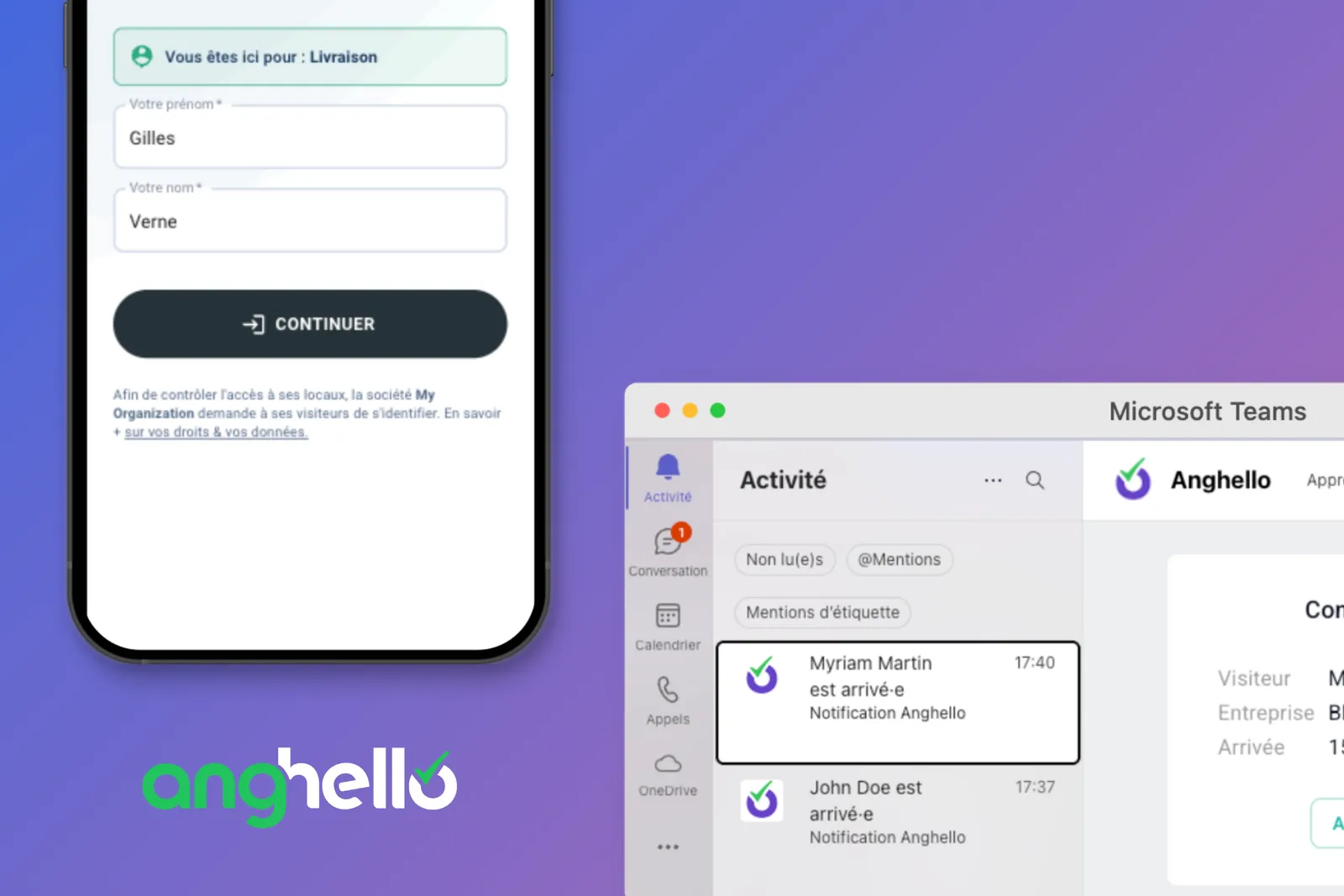
A visitor arrives on-site and checks in. Their host receives a notification directly in Microsoft Teams.
The goal isn't to add yet another notification channel. It's to integrate where your teams already work. The Anghello Teams plugin complements email and SMS notifications, ensuring better synchronization between a visitor's physical arrival and the moment their host is notified.
On sites without a permanent receptionist, this is a game-changer. No more watching the door or checking emails every five minutes — the notification shows up right where you're already looking.
👥 Visitor Types
Tailor the check-in process to the purpose of the visit.
A delivery driver in the logistics area, a maintenance contractor, a client attending a sales meeting, a quality auditor… You don't welcome them all the same way. And you shouldn't be asking them the same questions.
With visitor types, the check-in process adapts automatically: specific safety instructions, adjusted registry fields, targeted safety induction quizzes…
The result: the check-in flow matches the nature of the visit and the risk level, the visitor feels properly welcomed, and the visitor registry becomes more relevant — and more actionable when you need it.
🔐 Advanced User Management
Two simple adjustments that make a real difference.
You can now deactivate user accounts — temporarily or permanently — without deleting them: the action history is preserved, but access to the registry is immediately revoked.
Does your IT policy favor Azure SSO over traditional login/password? You can now enforce the authentication method when inviting a new user. Fewer accounts to manage, fewer stale passwords, and controlled authentication for your team members.
🗄️ Customizable Visit Data Retention
Take control of your visitor data lifecycle with ease.
Not every company has the same data retention policy. Some need to keep visit data for three months. Others, for over a year. And some want to anonymize quickly while still retaining the visit history.
You can now set the maximum retention period for visit data, independently from the auto-anonymization timeline.
In short: you align your registry management with your GDPR policy and regulatory requirements. True data governance, made simple.
👁️ Host List Privacy
Control solicitations right from the entrance.
By default, a visitor checking in can see the full list of employees they can contact. Depending on your context, that's perfectly fine — or not at all.
You now have three modes: display the full list by default, offer a search with autocomplete, or require an exact name entry.
It might seem minor. But on a sensitive site, limiting employee exposure and preventing unsolicited contact is a real concern. And it's just one setting away.
💡 And There's More…
A handful of smaller improvements have been rolled out over the past few months: a "Rating" field to customize visitor feedback questions beyond generic NPS, an optional CAPTCHA on check-in QR codes to prevent automated registrations, UX refinements in the visitor journey, performance optimizations…
Small details, sometimes invisible. But taken together, they make daily life better for your teams and your visitors!
🚀 Available Across Our Plans, Based on Your Needs
These updates address real challenges our customers face every day.
They're accessible across our plans — either included by default or available as optional add-ons.
We've also recently introduced a PREMIUM plan, designed for businesses and industrial sites that want to go further: customized check-in flows, an enriched visitor registry, advanced integrations, and strengthened compliance.
A plan built to balance risk management, operational efficiency, and regulatory requirements. Because reception is where it all begins.