
Visitor logs and GDPR: 5 common mistakes (that are easy to avoid)
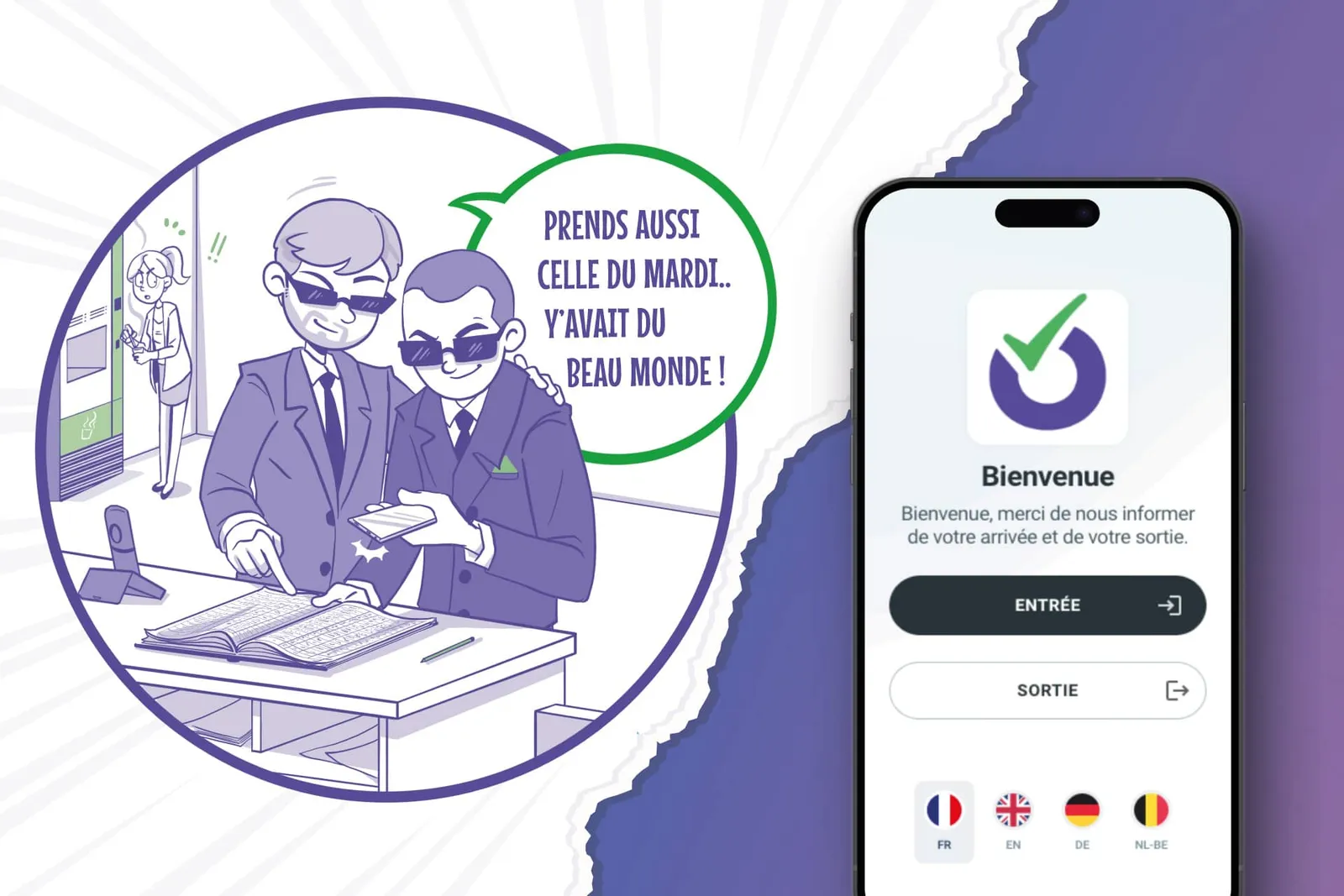
Every day, the same ritual is repeated: a pen, a book, a visitor scribbling their name in a box that is too small. Contractors, customers, job applicants… everyone goes through it. Simple and effective? Not really. Behind this seemingly harmless gesture lie very real risks: exposed personal data, sometimes confidential information left within reach of prying eyes, non-compliance risks, an outdated image… In short, the paper visitor log book is a bit like the fax machine of the reception desk - still there, but clearly from another era. And yet there are alternatives better suited to today's requirements: smoother, safer, more modern - in short, more Anghello. 😉
For a GDPR-compliant visitor log, let's go through the 5 most common mistakes seen in the field and, above all, how to avoid them easily.
Mistake no. 1: Using a paper visitor log book in full view of everyone
Your good old faithful spiral-bound book sits proudly at reception, open at today's page. Except that it also displays, quite unintentionally, the names, companies, visit times and signatures (and sometimes more) of everyone who came before. On paper (literally), this system in reality creates many GDPR non-compliance risks.
The list of non-compliance points for a paper visitor log book
- Confidentiality? Zero: the data is visible to everyone. A quick glance (or a quick snap with a smartphone) is enough to walk away with the full list of visits.
- Traceability? Weak: a paper log book does not provide reliable evidence: missing pages, writing errors, illegible names, omissions… And during a QHSE or GDPR audit, these weaknesses show up immediately.
- Security? Hard to control: the log book can be moved, lost, photographed… Some companies even discover that it is unofficially used as a “CRM” by passing sales reps.
The GDPR question
Personal data must be collected for a specific purpose (access control, security, safety, etc.), kept for a limited time, accessible only to authorised people, and above all not publicly disclosed.
A freely accessible paper log book makes these obligations difficult, if not impossible, to meet on a daily basis.
The right GDPR & security reflex
Adopt a digital visitor log, hosted in Europe, or even on a sovereign cloud. A digital visitor log designed to make GDPR compliance easier and to keep visitor information under control according to the rules defined by your company.
With Anghello, in its role as data processor, you benefit from reliable, usable traceability for a reception that finally lives up to your QHSE requirements.
Mistake no. 2: Not anonymising or deleting the visitor data in your log
In many companies, visitor data is kept… for far too long.
A bit like those archive boxes we promise to sort through “one day” - except that here, we are talking about personal data. Yet the General Data Protection Regulation (GDPR) requires you to be able to answer these three questions: What? Why? For how long? And this is often where everything is decided, and where a digital solution such as Anghello clearly makes things easier.
Indeed, many companies ask themselves: “How long should visitor log data be kept?” The CNIL (the French data protection authority) points out that the retention of visitor data must be strictly proportionate to the purpose. It must be limited to the time needed to ensure the security of the site and the traceability of arrivals and departures. It must also comply with the requirements specific to the sector of activity.
In practice, many organisations opt for short periods, often around 30 days, unless there is a particular need linked to security or internal obligations. Keeping this data indefinitely may constitute a breach of the storage limitation principle and of the right to erasure (Article 17 of the GDPR). Note that it is up to the data controller to set this period, and up to the solution used to ensure it is respected.
The right GDPR reflex:
Choose digital visitor management software with automatic anonymisation after a period defined by the company (as data controller), or manual anonymisation as required, and full traceability of operations. The result: data management that is under control and aligned with both your internal obligations and the requirements of the GDPR.
Mistake no. 3: Underestimating the traceability and reliability of information
Imagine a fire alarm. The building is evacuated, and the essential question arises of knowing exactly who was on the premises at that moment. You turn the pages of your old paper log book and discover a masterpiece of illegibility. In an emergency, this poses a real safety problem.
The essential pieces of evidence
To comply with the GDPR and meet QHSE requirements, you must be able to demonstrate:
- Who was present, at what time, and for what reason: a requirement that relates to security, safety and traceability alike.
- That the collection process is under control: declared purpose, authorised access and communicated retention period.
- That each visitor has been informed of their rights, in accordance with Article 13 of the GDPR.
The visitor log: a safety and compliance tool
A visitor log must provide:
- ✅ clear time-stamping of arrivals and departures,
- ✅ reliable traceability in the event of an evacuation or incident,
- ✅ evidence of preventive measures in the event of an internal or external audit,
- ✅ data integrity (no crossings-out, errors or missing pages).
The right GDPR reflex:
In practice, a paper log book makes these requirements hard to meet. Opting for a digital visitor management solution, designed to make them easier to meet, provides reliable traceability that can be used immediately in the event of an audit or incident.
This data reliability can also serve other goals, including environmental ones. By collecting suitable information, a digital log can help calculate the carbon footprint of visitors' travel, within the collection purposes that have been defined.
Mistake no. 4: Not knowing where and how visitor data is stored
“Where should visitor log data be stored to remain GDPR-compliant?” In an Excel file passed around by email? At the back of a drawer? Or on a cloud where you know neither the hosting country nor the processing conditions? Yet this arrival and departure data contains personal information. Poorly controlled, it can end up outside the EU, pass through third-party services without your knowledge, be viewed by unauthorised people, or simply end up in unsuitable tools.
This is why the GDPR requires appropriate technical and organisational measures to be implemented (Article 32). They include control over data hosting, authorised access and any transfers outside the EU. Their aim: to guarantee the confidentiality, integrity, availability and traceability of information.
The right GDPR reflex when choosing GDPR-compliant visitor management software:
- hosting in Europe, possibly on sovereign infrastructure, with no transfer outside the EU,
- control over processors and processing operations (Article 28 of the GDPR),
- controlled access to ensure that only authorised people can access the data,
- a retention policy that is defined and applied, with anonymisation or deletion as required,
- shared transparency through a data processing agreement (DPA) detailing the processing operations, the sub-processors, the hosting and the protective measures.
Mistake no. 5: Underestimating the visitor experience and brand image
The welcome begins even before the first hello. Too many companies still see the visitor log as a mere administrative formality. Yet it directly influences the first impression given to a customer, a contractor or a job applicant. A paper visitor log book? Effective… until it no longer is: a temperamental pen, illegible handwriting, torn pages… These small points of friction really do not make a good impression and are out of step with the company's standards and professional culture.
Why does this really matter, for the GDPR as well as for QHSE?
- Operational efficiency: quick, clear, error-free check-in that frees up time for teams (and for visitors).
- Security and compliance (audit, GDPR): fewer errors, better quality data collection and easier audits.
- Image & professionalism: a modern welcome, consistent with your image and your commitments.
Digitising the visitor log therefore brings more than mere convenience: it is a way of ensuring a welcome that is consistent with your internal practices, your commitments and your GDPR obligations.
With a digital visitor log for businesses, your teams save time and your visitors feel expected and welcomed, in a professional and modern way.
FAQ - Visitor logs and the GDPR in 5 questions
How long should a visitor log be kept?
Only for the time needed for its purpose (often 30 days, unless there is a specific need). With Anghello, the period is configured according to the rules you define as data controller.
Is a paper visitor log book GDPR-compliant?
In theory yes, in practice rarely. It offers little security and its data is visible to everyone, personal information is exposed and retention is often not under control. A digital log makes confidentiality, traceability and access rights management easier.
How do you anonymise a visitor log book?
Anonymisation consists of making data permanently non-identifying, in an irreversible way.
With a digital solution such as Anghello, anonymisation is automatic, with no manual intervention, according to the retention rules you have defined.
What is the difference between a visitor log and a safety register?
The first manages day-to-day visits, the second presence in the event of an incident. In France, in an establishment open to the public, the content of the safety register is in fact set by the French Construction and Housing Code. With Anghello, you combine the two in a single solution: a reliable visitor log and an evacuation module able to display the people present in real time, track roll calls and generate a full report at the end of the incident.
How do you prove the GDPR compliance of your visitor log during an audit?
During an audit, you must be able to demonstrate: the purpose of the collection, the retention period and how it is applied, the security of the data and the information given to visitors.
With Anghello, there is no need to dig around: everything is time-stamped, documented and accessible in one click.