
Workplace safety instructions: understanding them and putting them in place
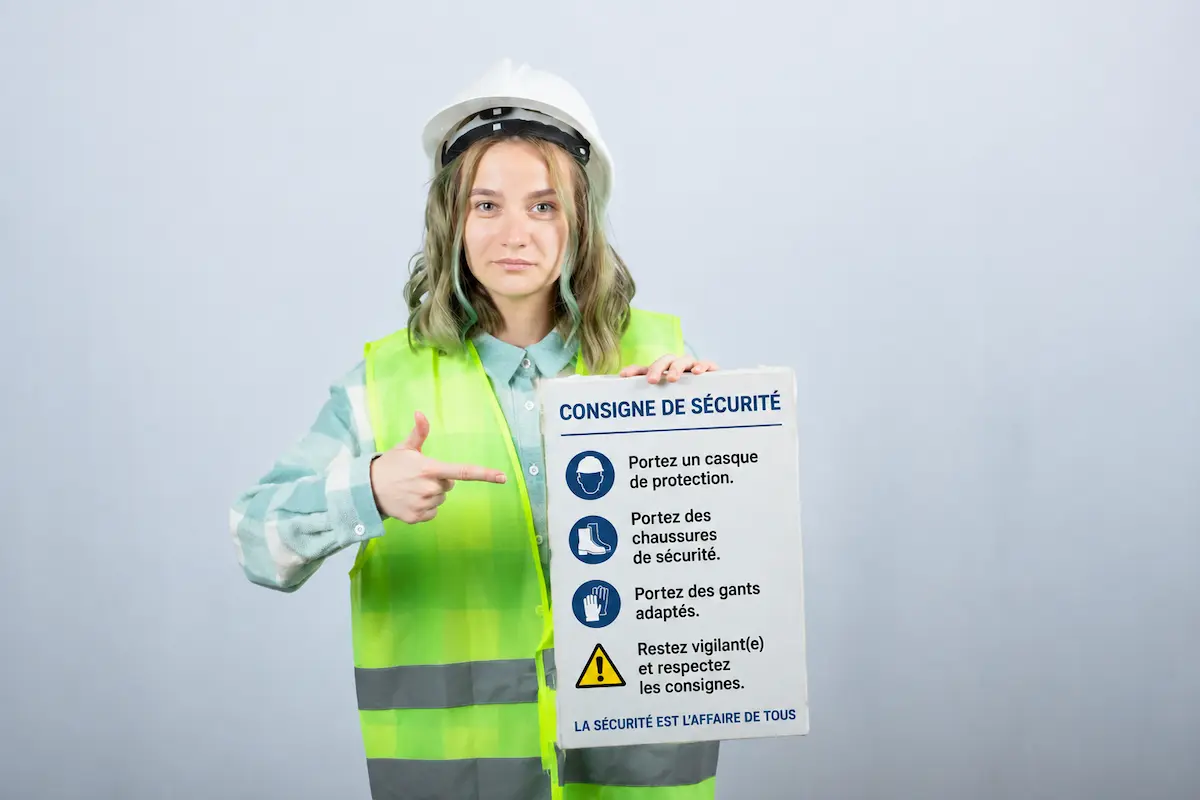
Every safety instruction has one simple purpose: making sure that everyone who enters your premises, whether an employee, a visitor or a contractor, leaves in the same good health as when they arrived. And beyond people, these rules also protect your site: its facilities, equipment and sensitive information. The stakes are anything but theoretical: in 2024, the French national health insurance fund recorded nearly 550,000 workplace accidents resulting in time off work and 764 deaths, with more than 20% of those deaths occurring during the first year in the job, precisely when the instructions have not yet become second nature. Yet even though there is a legal obligation to display these instructions, the reality on the ground is quite different: signs that nobody looks at any more, and procedures and instructions that visitors and newcomers have not understood, or even read.
Let's take stock of what safety instructions are, the different types you may come across in a business, and above all how to put them in place so that they are read and genuinely understood.
What is a safety instruction?
A safety instruction is a set of written directions explaining what to do to prevent a risk or respond to a dangerous situation. Whether it concerns a fire breaking out, a gas leak or an accident, it answers three simple questions: what to do, how to do it and whom to contact.
Note that a safety instruction is also a legal obligation: the French Labour Code requires employers to protect the physical and mental health of their teams (Article L4121-1). In addition, Article R4227-37 makes fire safety instructions mandatory in establishments where more than 50 people are usually present, as well as in those where flammable materials are handled. These instructions must be displayed very prominently: in every room accommodating more than 5 people, and otherwise in every room or corridor serving a group of rooms.
In short: having safety instructions and displaying them is in no way optional. But they also need to be understood by everyone, a point we will come back to.
The Labour Code is, moreover, only the foundation: ISO 45001 (health and safety), ISO 14001 (environment) and ISO 27001 (information security) certifications require instructions that are documented, communicated and traceable, including for visitors and outside companies. The French MASE standard makes them a condition of access to industrial sites for contractors, and SEVESO or ICPE sites have reinforced instructions imposed on them by prefectoral order. In all these frameworks, proving who received and understood which instruction becomes as much an audit issue as a prevention issue.
What are the different types of workplace safety instructions?
Safety professionals traditionally distinguish between general instructions, which apply to everyone and everywhere on the site, specific instructions, which relate to a particular room, piece of equipment or operation (battery charging room, boiler room, job safety sheet or safe operating procedure for a machine, etc.), and special instructions, intended for certain categories of staff such as emergency response team members. In practice, these instructions cover 5 main topics almost everywhere:
Fire safety instructions
Fire safety instructions specify the location of fire extinguishers and how to use them, how the alarm works, the emergency numbers to call (18 or 112 in France), as well as the people responsible for guiding the emergency services and those trained to use firefighting equipment.
They must also provide for the evacuation of people with disabilities: who accompanies them, and where the safe waiting areas are located (Article R4227-38).
Because they let everyone know who does what during a fire, they are logically the most tightly regulated.
Evacuation instructions
A fully-fledged part of the fire safety instructions, evacuation instructions designate the assembly point (the place where everyone must gather, away from the building), as well as the people who oversee the evacuation: the evacuation guide, who leads occupants to the exits, and the sweeper, who checks that nobody is left behind in an area. To do this, the instructions rely on the evacuation plan displayed on the premises.
In establishments subject to fire safety instructions, Article R4227-39 of the French Labour Code requires tests and drills at least every six months: recognising the alarm signal, using first-response equipment, carrying out evacuation manoeuvres. The dates of these drills and the observations arising from them are recorded in a register kept available to the labour inspectorate.
And it is precisely during these drills that one question comes up time and again: do we know exactly who is on site at this moment? Employees, yes, generally. It is much more rarely the case for visitors and contractors (outside companies), especially when the visitor log is a paper log book. Reliable recording of arrivals and departures is essential if you are to account for everyone at the assembly point. And this is where digital has the edge over paper: the list of people present can be viewed in real time from a phone, whereas the paper log book has sometimes been left inside the building that has just been evacuated.
Gas and electricity safety instructions
This type of instruction specifies where the gas shut-off valves and electrical panels are located, who is authorised to work on the installations, and what to do in the event of a leak or incident: cut off the supply, ventilate, avoid creating sparks or operating switches, inform the person in charge, etc. It also recalls a simple rule: only authorised people work on electrical installations, and always with the power off, after lockout, barring strictly controlled exceptions.
First aid instructions
In a context where the first few minutes make all the difference, first aid instructions set out the 3 fundamental reflexes to adopt in the event of an accident, known in France by the acronym PAS (protéger, alerter, secourir): protect, alert, assist. They also indicate the location of the first aid kit, the names of the workplace first aiders (SST) trained within the company, and the emergency numbers: in France, 15 for the ambulance service (SAMU), 18 for the fire brigade, 112 (the European emergency number) and 114 by text message or video call for people who are deaf or hard of hearing. Everyone must be able to find them in a few seconds, without thinking.
Site rules
This type of instruction is often presented as a list of prohibitions. For our part, we prefer to make it a list of good habits to adopt. Keeping to pedestrian walkways, wearing personal protective equipment (PPE) in the areas that require it, smoking only in designated areas, not bringing in unauthorised equipment: these simple rules protect everyone on a daily basis, people as well as the site's facilities and sensitive information. Worded positively and explained, they are far better accepted than blunt prohibitions pinned to the wall.
The 12 golden rules of workplace safety
In industrial environments and on construction sites, many organisations supplement their instructions with safety “golden rules”. Each organisation defines its own, but many large groups settle on a dozen or so, built around the high-risk situations that account for the majority of serious accidents:
- Traffic: pedestrians and vehicles use separate, marked routes.
- Wearing PPE (personal protective equipment): helmet, safety shoes, gloves and safety glasses, suited to the area and worn at all times.
- Handling tools and equipment: a checked tool, used for the purpose it was designed for.
- Pressure hazards: pressurised circuits are bled before any work is carried out.
- Lifting operations: marked-off area, controlled load, nobody walks under the load.
- Working at height: collective protection first, a harness when collective protection is impossible.
- Excavation work: the walls are shored or propped before anyone goes down.
- Confined spaces: atmosphere tested and outside supervision in place before entering.
- Ignition hazards: no hot work without a hot work permit in sensitive areas.
- Work on energised systems: systematic lockout before any work is carried out.
- Moving machinery: eye contact with the driver before approaching.
- Chemical hazards: labels read, protective equipment worn, products never decanted without being identified.
Each of these rules deserves a place in the site's own instructions: every person exposed must know them before finding themselves in the situation, whether they are a contractor, a long-standing employee or a temporary worker.
How do you put safety instructions in place properly in your business?
Following these 7 steps will help you put effective safety instructions in place in your business.
Identify and assess the occupational risks in your business
All these risks come from the field. The risk assessment, formalised in France in the single risk assessment document (DUERP) and mandatory from the very first employee, identifies the hazards specific to each job, each area and each activity. For example, there is no point displaying a “Chemical hazard” instruction in a consultancy firm, whereas it is essential in a workshop.
Define suitable safety instructions
Each significant risk identified must have its own instruction. A good instruction is specific: it talks about your premises, your equipment or your internal emergency numbers. A safety instruction template can be used, but it must be adapted to the characteristics of the premises. This work is best carried out with the CSE (the French social and economic committee) or its health, safety and working conditions committee (CSSCT): staff representatives know the field, and their involvement strengthens buy-in to the instructions.
Write clear and concise instructions
Think about the context in which a safety instruction is read: it is often read in a few seconds, at a stressful moment. Short sentences, one message per instruction, action verbs, standardised pictograms (ISO 7010). Their colour code is a universal language, understood even before it is read: red for prohibition and fire equipment, yellow for danger, blue for mandatory actions, green for first aid and evacuation. And black and white on supplementary signs for information.
A good way to test whether your instruction is effective is to have it read by someone discovering your premises for the first time: if they understand it immediately, first time round, you have succeeded.
In France, instructions must be written in French (Article L1321-6 of the French Labour Code). If your sites welcome people who speak other languages, add suitable translations: an instruction that is not understood does not protect anyone.
Display the instructions and communicate them before arrival
Displaying the instructions as required by the regulations (visible signs, evacuation plans on every floor) is the baseline. But for outside people invited onto the site, such as visitors, contractors or temporary workers, the best time to pass on the instructions is before they arrive on site. Sending them the entry instructions in advance, then having them read and accept them at check-in, ensures that nobody moves around your premises without having seen them.
For outside companies, this communication falls within a precise legal framework in France: the prevention plan (Articles R4512-6 et seq. of the French Labour Code), which formalises the risks arising from several companies working on the same site. Temporary workers, for their part, are treated as employees of the user company: when assigned to high-risk jobs, they receive a safety induction and enhanced job-specific safety training (Article L4154-2). Hauliers are a special case: for loading and unloading operations, it is the safety protocol that applies (Articles R4515-4 et seq.), and the driver must be aware of it before working on site. Finally, on building and civil engineering sites, health and safety coordination (SPS) and its site register take over.
Expectations also vary by activity: we have set them out, standard by standard, on our pages dedicated to visitor management in food manufacturing and visitor management on industrial sites.
This is exactly what a digital visitor log such as Anghello makes possible: visitors read and accept the instructions when they check in, in a few seconds, in their native language. Visitor reception thus becomes the site's first line of prevention, rather than a mere formality. An often overlooked point: a visitor log processes personal data… a digital tool makes GDPR compliance and confidentiality easier, whereas a paper log book left at reception lets every visitor read the names of those who came before. Another blind spot is where this data is located: choosing a solution hosted in the European Union avoids exposing your visitor log to non-European legislation such as the US CLOUD Act.
Want to learn more about our visitor management solution?
Schedule a personalized demo or contact an advisor to discuss your needs.
- Book a Demo
- Contact Sales
Schedule your personalized demo
Choose the time slot that suits you best and provide your information:
Train people in the right safety practices
An instruction that has been read is good. It is even better when the action has been practised. Six-monthly evacuation drills, fire extinguisher training, refresher training for workplace first aiders (in France, the MAC SST course every 24 months): these are the practices that turn instructions into reflexes. The people overseeing evacuations (evacuation guides and sweepers) must be appointed, trained and known to everyone.
Check that people have understood the instructions
The last step, often forgotten: making sure the message has got through and been understood. For teams, this is done through safety toolbox talks and drill debriefs. For visitors and contractors, through an induction questionnaire (or safety induction quiz), that is, a few questions asked after the instructions have been read to check they have been understood before access to the site is granted. On industrial sites, this is often the difference between an administrative formality and a genuine prevention barrier.
Keep the instructions alive over time
An instruction is never set in stone. Building work, a new layout, new equipment, feedback from a drill or an accident: every change to the site must trigger an update, in line with the update of the risk assessment document. This is also where digital makes the difference: a digital instruction is updated instantly and passed on in its current version to every new arrival, whereas the paper poster often waits for the next print run… in each of the languages.
A displayed instruction is not necessarily an understood instruction
Putting safety instructions in place is not just about ticking a regulatory box: it is about making sure that every person on your site (including someone who is only there for an hour) knows what to do if something does not go as planned.
Companies that succeed in this have one thing in common: they treat their visitors and outside companies in the same way as their employees. Instructions sent before arrival, an induction questionnaire to check understanding, a reliable record of who is on site in the event of an evacuation: this is precisely what Anghello provides for companies that want to welcome people safely, without complexity.
Frequently asked questions about safety instructions
Which safety instructions are mandatory in the workplace?
It depends on the risks specific to each site, identified in the risk assessment document (DUERP in France). At a minimum, all establishments must draw up instructions ensuring that occupants can be evacuated quickly. Fire safety instructions, for their part, are mandatory above 50 people or where flammable materials are present: their precise content and display rules are detailed in our article dedicated to fire safety instructions. Added to these, depending on the activity, are gas and electricity instructions, first aid instructions, the wearing of PPE and on-site traffic rules.
Who writes the safety instructions in a company?
The employer is responsible for writing them, under its general safety obligation (Article L4121-1 of the French Labour Code). In practice, it relies on the QHSE/HSE manager where there is one and on the risk assessment in the DUERP, and involves the CSE or the CSSCT. The instructions must be adapted to the premises and the real risks of each site.
When should safety instructions be updated?
Whenever the risks change: a new layout of the premises, new equipment, a new process, a change in the designated people (first aiders, evacuation guides, sweepers), and at the very least every time the risk assessment document is updated. Feedback from drills or incidents is also a good trigger: if an instruction was not understood or applied, it needs to be rewritten. An out-of-date instruction, a number that no longer answers or a plan that no longer matches the premises gives false reassurance: better to correct it without delay.
In which language must safety instructions be written?
In France, they must be written in French (Article L1321-6 of the French Labour Code); other countries apply their own language rules. Translations can, and in practice should, be added when the site welcomes employees, contractors or visitors who do not have a good command of French: an instruction that is not understood does not protect anyone.
Do visitors and contractors need to know the safety instructions?
Yes. Everyone on the site must know how to react in an emergency. For outside companies, a prevention plan formalises the risks arising from several companies working on the same site (Articles R4512-6 et seq.); for loading and unloading operations, it is the safety protocol that applies (Articles R4515-4 et seq.). The best time to pass on the instructions to visitors and contractors remains before they arrive on site.
What is the difference between safety instructions and the internal rules?
In France, the internal rules (règlement intérieur), mandatory from 50 employees, set out the general and permanent rules on health, safety and discipline (Article L1321-1). Safety instructions are operational and location-specific: they say what to do, here and now, in a dangerous situation. They can be appended to the internal rules, but their place is above all in the field: displayed, communicated and understood by everyone present.
What does a company risk without safety instructions?
The absence of mandatory instructions exposes the employer to the penalties provided for in the French Labour Code, identified during labour inspectorate checks. Above all, in the event of an accident, it can constitute a breach of the safety obligation and give rise to the employer's civil and criminal liability, in particular on the grounds of inexcusable fault (faute inexcusable).