
Food defence and visitor management: what the standards require
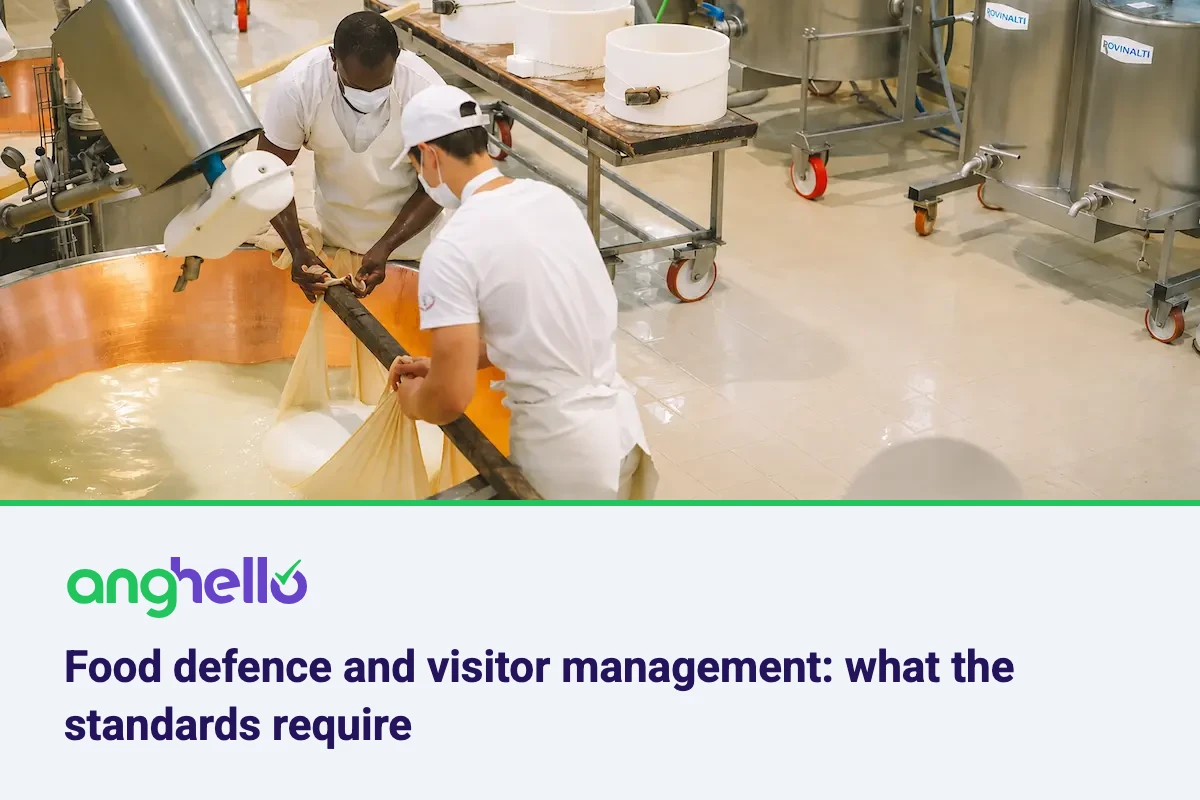
Food defence is the protection of food against intentional contamination: an act of malice, sabotage, revenge or terrorism intended to harm consumers or the business. It differs from food safety, which deals with accidental contamination, and from food fraud, which deals with economically motivated deception. The three GFSI-recognised standards used in France, IFS Food, BRCGS and FSSC 22000, require a documented food defence plan. US regulations impose one on sites that export to the United States.
This article explains what each framework requires, clause by clause, and focuses on the point that all four have in common and that an auditor can test simply by arriving at reception: controlling the access of external personnel to sensitive areas.
Our food manufacturing clients regularly talk to us about food defence. Their questions have led us to look more closely at the requirements that govern visitor management. To design a tool suited to the way they work, we needed to understand what is at stake from the moment someone from outside the business arrives: identifying them, the instructions to give them and the conditions of their access. Who is expecting them? Which areas may they enter? Which instructions must they understand before entering those areas or starting their work?
A technician working near a tank, a driver unloading bulk goods and a sales representative received in the offices are involved in different activities. The areas they access and the conditions of their presence determine the risks to take into account, and the visitor induction process must reflect those differences.
What is food defence?
Food defence covers intentional acts. The key word is intentional. A site's HACCP plan deals with hazards that arise by accident or through negligence: a break in the cold chain, a foreign body from a machine, allergen cross-contamination. Food defence deals with a person who wants to cause harm and who is looking for the point in the process where their act will have the greatest effect and the least chance of being detected. A food defence plan therefore protects the product against intentional contamination, where the HACCP plan protects against accidental contamination.
The industry distinguishes three related concepts, which auditors expect to see treated separately:
- Food safety: unintentional contamination, addressed through good hygiene practices and the HACCP plan.
- Food fraud: adulteration or substitution motivated by economic gain, for example a diluted ingredient or a falsified origin. IFS Food covers it in chapter 4.20, with a vulnerability assessment often referred to as VACCP.
- Food defence: intentional contamination motivated by the intent to cause harm. IFS Food covers it in chapter 4.21, with a threat assessment often referred to as TACCP, described in the British guide PAS 96:2017.
The motivations encountered are varied: an employee in dispute with their employer, a dismissed contractor, an attempt to extort a brand, an ideologically motivated act. The founding case of the discipline remains the deliberate contamination of salad bars in The Dalles, Oregon, in 1984, by members of a community who wanted to influence a local election: 751 cases of salmonellosis were recorded, according to the study published in JAMA in 1997. The most frequently cited factory case is that of Aqli Foods in Japan: in October 2013, an operator on the pizza line introduced malathion, a pesticide, into frozen products. More than 6 million packs were recalled and nearly 2,800 people reported mild symptoms to the health authorities, without a causal link being established for each of them. The employee was arrested at the end of January 2014.
Threat assessment and sensitive areas
A food defence plan begins with a threat assessment, which the FDA calls a vulnerability assessment and which PAS 96 structures under the name TACCP. The method is similar to HACCP, but the question changes: no longer "what could go wrong?", but "who might want to cause harm, where, and with what chance of succeeding without being seen?".
The assessment combines three dimensions for each step of the process: the likelihood that an attacker has access to it and a reason to act, the severity of the effect on consumers and the size of the batch affected, and how difficult it would be to detect the act before the product is dispatched. The result is a list of sensitive areas, sometimes called critical areas, where a malicious act would be diluted across an entire batch and would go unnoticed at the final check, and, for each of them, mitigation measures proportionate to the threat assessed.
The FDA has identified four types of activity where vulnerability is concentrated in most factories: bulk liquid receiving and loading, liquid storage and handling, secondary ingredient handling, and mixing and similar activities. These four points are found at virtually every food manufacturing site, and they have one thing in common: they are areas where external personnel carry out work, for a delivery, cleaning or maintenance.
What IFS 4.21, BRCGS 4.2, FSSC 22000 and the FDA require
The three GFSI-recognised standards and the US regulation ask for the same thing in different words. Reading them together avoids having to maintain three plans.
| Framework | Clause | What is required | Review |
|---|---|---|---|
| IFS Food v8 Published in April 2023, mandatory since 1 January 2024 | 4.21.1 to 4.21.3 |
| Effectiveness test and review at least once within a 12-month period, or whenever a significant change occurs |
| BRCGS Food Safety Issue 9 Published in August 2022, audits since February 2023 | 4.2.1 to 4.2.3, and 4.1.4 |
| Review at least annually |
| FSSC 22000 v6 Published in April 2023, audits since April 2024 | Additional requirement 2.5.3 |
| In line with the management system cycle |
| FDA, 21 CFR Part 121 Final rule of 27 May 2016, compliance from July 2019 to July 2021 | Mitigation Strategies to Protect Food Against Intentional Adulteration |
| Reanalysis at least every three years |
These four frameworks are not of the same nature. IFS Food (International Featured Standards, created by the German and French retail federations), BRCGS Food Safety (which grew out of the British Retail Consortium) and FSSC 22000 (Food Safety System Certification, which combines ISO 22000, sector-specific prerequisite programmes and additional requirements) are private certification standards recognised by the GFSI: customers require them as part of the commercial relationship, but they do not replace the site's regulatory obligations. The FDA's (Food and Drug Administration) 21 CFR Part 121, by contrast, is a regulation, applicable depending on the facility's activity and its exemptions. Packaging manufacturers are covered by their own standards, IFS PACsecure and BRCGS Packaging Materials, which are not covered here.
A note on timing for FSSC 22000: the Foundation published version 7 of the scheme on 1 May 2026. Audits against version 6 remain possible until 30 April 2027, and upgrade audits to version 7 take place from 1 May 2027 to 30 April 2028. The food defence requirement is carried over; check the clause numbering in the version that will apply to your next audit.
Three observations emerge from this table.
First: IFS clause 4.21.2 explicitly cites "the access policy for employees, visitors and contractors" and "the management of external inspections and regulatory visits" among the minimum content of the plan. Access by external personnel is not the auditor's interpretation; it is written into the clause.
Second: BRCGS is the only standard that asks, in so many words, for a visitor registration system. Clause 4.1.4 complements clause 4.2, entitled "site security and food defence", on sensitive areas. A BRCGS auditor will therefore ask to see the visitor log, then check that visitors and drivers were informed of site access procedures before entering.
Third: the US rule is the most prescriptive on the structure of the plan and on responsibility. When the rule was published, the FDA estimated that around 3,400 companies operating 9,800 facilities were covered, in the United States and abroad. A French site that exports to the United States and is registered with the FDA falls within this scope, whatever the volume exported. Its IFS plan can serve as a basis, but it does not count as an FDA plan until it has the five components of the written plan, the qualified individual and the reanalysis.
For a food manufacturing site, these requirements come on top of those that already apply to visitor hygiene. In IFS Food v8, requirement 3.2.2 on personal hygiene applies to contractors and visitors, and it is one of the ten KO requirements: scored D, it deducts 50% of the points and prevents the certificate from being issued. We have set out these requirements on our page on visitor management in food manufacturing.
FDA: check the scope before writing the plan
21 CFR Part 121 targets intentional contamination intended to cause wide-scale public health harm. It applies to a French factory as soon as it manufactures, processes, packs or holds food intended for consumption in the United States and is registered with the FDA. Before writing an FDA plan, two checks are needed: registration, then the exemptions in §121.5, which are examined activity by activity: holding of food other than in liquid storage tanks, operations on a container that remains intact and in contact with the food, animal food, and the very small business threshold of 10 million dollars adjusted for inflation, calculated over three years, subsidiaries included, with supporting documents retained for two years. The same site may be exempt for one workshop and covered for another.
Three points in the text then affect how external personnel are received. §121.4 distinguishes between awareness for the people assigned to vulnerable steps, which an induction quiz can support for an external contractor, and the qualification of those who prepare the plan, which that quiz does not demonstrate. §121.157 requires a reanalysis at least every three years, but also whenever a change creates or increases a vulnerability: a new loading bay, outsourced cleaning or a change in delivery times raises the question during the project, not after it goes live. §121.315 sets a two-year retention period for the records required by the plan, available on site within 24 hours; this period does not automatically apply to the whole visitor log, a point we return to below with the CNIL's recommendation.
External personnel: visitors, contractors, drivers
A food manufacturing site receives more people from outside the business than you might think. According to Anghello statistics recorded in 2026, an average of 27 people a day and nearly 135 a week arrive at a food manufacturing site: maintenance contractors, cleaning staff, hauliers, auditors, sales representatives, job applicants. Each of these people falls within the scope of the food defence plan as soon as they can get close to a sensitive area, and access control begins with knowing who they are and what they have come to do.
Three groups raise different questions.
Visitors and auditors are accompanied, expected, and come through reception. The risk they represent is low, but evidence of their visit is the most frequently requested: who came, with which host, at what time, into which areas, and which instructions they accepted.
Maintenance and cleaning contractors are the ones who actually get close to sensitive areas, often outside production hours, sometimes at night when the site is empty. Their access is governed by the prevention plan, mandatory in France for any work carried out by an external company and required in writing above 400 hours a year or for hazardous work (Articles R4512-6 et seq. of the French Labour Code). The prevention plan deals with the safety of people; the food defence plan must deal, for the same contractors, with access to products.
Drivers are the largest and least traceable group of external personnel. They arrive early, often before reception opens, manoeuvre at the loading bay and leave without having met anyone other than the forklift operator. Their visit falls under the safety protocol for loading and unloading operations (Articles R4515-4 et seq.). In most of the food defence plans we see, the "visitors" section is a single line, "badge required", and drivers do not appear in it. Yet the loading bay is where bulk liquids are received, one of the four vulnerable activities identified by the FDA.
Starting from the planned activity makes it possible to define, for each person from outside the business, the areas they may access, the responsibilities and what must happen before entry.
| Situation | Points to examine depending on the site's risks |
|---|---|
| Visit to the offices | Identification, person visited, movement around the site and access limits |
| Maintenance work in production | Authorisation, job-specific instruction, access to equipment and supervision by a designated person |
| Delivery or loading | Movement around the site, waiting area, access to the loading bay or bulk unloading point and designated contact |
| Cleaning outside production hours | Authorised areas, access to products or equipment and supervision arrangements |
For regular contractors, three pieces of information answer three different questions and must not be confused: the validity of the safety induction, the access authorisation for the day's job, and the actual entries and exits. A maintenance company may be on site every week without all its employees having the same jobs; a change of technician or work area justifies a new validation. Familiarity with a company does not replace checking the day's job.
The insider threat
The most visible food defence measures are perimeter measures: fence, gate, cameras, badges. They match the image of an intrusion. Yet the US rule was built around another assumption, that of the insider threat, meaning the person who already has legitimate access to the site and knowledge of the process. The Aqli Foods case illustrates this: the perpetrator worked on the line, knew the schedules and the checks, and acted four times over a week before consumer complaints came in.
This assumption changes the order of priorities. A fence does not protect against an employee. What protects against intentional contamination from the inside is organisation: the two-person rule at mixing steps, seals on tanks and containers outside production, chemicals stored away from production areas, supervised onboarding of temporary workers, badges deactivated on the day someone leaves, and a reporting culture in which unusual behaviour is reported without fear of sanction.
The insider threat also includes regular external contractors, who know the site almost as well as employees: the night cleaner, the maintenance technician under contract. For them, instructions accepted on each visit and the presence of a site employee during work in sensitive areas are mitigation measures in their own right, not reception formalities.
Audit evidence: an accepted, time-stamped instruction for each visitor category
The auditor does not ask whether the site has visitor badges. They ask who entered the mixing room on a given day, and how the site knows. A badge on loan proves that a badge was lent. A paper log book at reception proves that a name was written down, sometimes legibly, rarely with the exit time and never with the instructions the person received. What a food defence plan must be able to show an auditor is not the list of measures, but the record of their application for a given person and date.
The evidence expected by the four frameworks is made up of four items for each person from outside the business: their identity and company, their reason for visiting and their host, their entry and exit times, and the instructions they accepted before entering, in a language they understand. For a contractor entering a sensitive area, add the prevention plan or the permit to work, and for a driver, the safety protocol. For a regular contractor, the evidence also includes the validity of the safety induction: the date on which the instructions were last presented and the quiz last taken, and the period for which the site considers them valid.
Here is what this evidence looks like for a maintenance contractor under contract, at a fictitious site: the contact record shows their category, their company and the date their identity was verified, followed by their safety history with the date and time the instructions were last presented, those of the last induction and the quiz result.
A recorded visit, an access authorisation and an instruction that has been applied are three separate facts, and a line in the entry log demonstrates only one of them. If the procedure requires authorisation before access to an area, you must be able to retrieve that authorisation. If it requires a specific instruction, you must be able to document that it was given. To choose which records to keep, three questions are enough:
- Which measure in the plan does this record correspond to?
- How is the reliability of the information checked?
- What action does the procedure provide for when the team identifies a deviation?
This is why the visitor induction process is the right place to produce the evidence. The instructions are presented before exposure to the risk, ideally even before arrival thanks to visitor pre-registration, then understanding is checked with an induction quiz of a few questions, and acceptance is time-stamped and linked to the person. For regular contractors, the date of the last safety induction and its validity period avoid having to repeat everything on each visit. For drivers, a QR code at the loading bay makes it possible to present the instructions in their language, even at five in the morning, without going through reception.
This evidence is what is most often missing from an inherited food defence plan. The plan describes measures; it does not say where to find the record that proves the measure is applied.
Want to learn more about our visitor management solution?
Schedule a personalized demo or contact an advisor to discuss your needs.
- Book a Demo
- Contact Sales
Schedule your personalized demo
Choose the time slot that suits you best and provide your information:
Testing the visitor induction process in real conditions
A procedure can describe visitor management correctly without covering every day-to-day situation. The effectiveness test required by IFS 4.21.3 and the annual BRCGS review are an opportunity to check this on site, with a scenario chosen from among the site's risks: an arrival without an appointment, an out-of-hours delivery, work in an area that is usually closed, a visitor who tries to enter a sensitive area without a host.
The expected outcome is defined before the exercise. For example: the team identifies the person authorised to approve entry, communicates the instructions before access to the area, and the visit leaves a time-stamped record. The process is then observed, without exposing people or products to unnecessary risk.
When a deviation appears, the useful question is not "who was at fault?" but "what prevented the procedure from being applied?": unclear responsibility between reception and the host, an instruction that cannot be found at the time of arrival, no one to take over when the host leaves the site, an authorisation that is too broad, granted to a company rather than to a person. A clear explanation and an appropriate check achieve more than a general reminder. The report of the exercise, dated and signed, is the evidence of the test that the auditor will ask for.
Rolling out food defence across a multi-site group
In a group, the head-office quality manager faces a practical problem: five factories, five plans written at different times, five reception log books, five ways of writing "visitor". No consolidation is possible, and each audit is prepared site by site.
The approach that works separates a group-wide core from a site-specific appendix. The core sets the threat assessment method, the scoring grid and its scales, the list of typical attackers, the catalogue of generic mitigation measures with the evidence expected for each, the training programme and the instruction templates. The site appendix contains the site plan, the sensitive areas selected, the completed assessment table, the local measures, the named team and the date of the last review.
For external personnel, consolidation requires a visitor log shared by all sites, with the same instructions for each visitor category, the same quizzes and exports by site, by reason for visit and by period. Head office can then answer a group auditor without calling each factory.
The validity of the safety induction then becomes group-level data. Kept by site and by person, it shows for each recurring contractor when they last received the instructions and took the quiz, and until when that induction remains valid. Consolidated at head office, it makes it possible to identify contractors whose validity is expiring at several factories, to check that a national contractor has been inducted at every site where they work, and to answer a group auditor who asks for the date of a given external company's last safety induction.
Food defence in France: Vigipirate, the Labour Code, the CNIL
Three French frameworks come on top of the standards and sometimes cause confusion.
The Vigipirate plan deals with the terrorist threat. In January 2014, the General Secretariat for Defence and National Security (SGDSN) published a guide of recommendations for protecting the food chain against the risks of malicious, criminal or terrorist acts, updating a first version from 2007. This guide is circulated by the prefectures and remains the national reference. It is not aligned with the IFS or BRCGS clauses, but nothing prevents you from having a single food defence plan that meets both: the auditor wants to see the threats assessed and the measures documented, the prefect wants to see that the terrorist threat is among the scenarios.
The French Labour Code already governs external contractors through the prevention plan and hauliers through the safety protocol. These two documents and the food defence plan are about the same external personnel. They must share the same list of contractors and refer to one another, otherwise the site ends up keeping three contradictory lists.
Finally, the CNIL, the French data protection authority, recommends that access log data be deleted three months after it is recorded, for employees and visitors alike. This period applies to the log of entries and exits. It does not prevent the retention of safety induction evidence, accepted instructions, quiz answers, permits to work, for the period needed for the audit cycle, nor the two years of §121.315 for the records required by the FDA: these are separate records, with different purposes and retention periods, to be set separately and documented in the visitor privacy notice. We have covered this point in detail in our article on the visitor log and the GDPR.
What the auditor can test by arriving at reception
Food defence largely plays out inside the site, in the organisation of sensitive areas and the vigilance of teams towards the insider threat. But the only part of the plan that an auditor can test live, without asking for anything, is reception: they arrive, observe whether they are given instructions, whether anyone checks that they have understood them, whether they are accompanied, and whether their visit leaves a time-stamped record. A site that maintains this process for every visitor, every contractor and every driver has secured the first piece of evidence for its plan, controlling the access of external personnel, the one that is common to IFS, BRCGS, FSSC 22000 and the FDA.
How Anghello supports visitor management
Anghello covers this part of the plan: presenting instructions by visitor category and by language, checking understanding with a quiz, recording visitors in a time-stamped log, and keeping the history of the instructions accepted and the answers given, which you can retrieve for each person and each visit.
When a visitor fails the quiz, their safety induction is marked KO and their host and reception are notified. They must retake the quiz on each visit until they pass. This status allows your team to handle the situation in accordance with your procedure; it does not trigger any physical blocking of access.
Your teams define the rules, the authorisations and the responsibilities. Anghello does not issue any certification and does not replace your threat assessment, your food defence plan or your physical access control systems.
Frequently asked questions about food defence
Food defence or food fraud: what is the difference for the auditor?
Food fraud is economically motivated deception, a diluted ingredient or a falsified origin; food defence is intentional contamination intended to cause harm. IFS Food v8 covers them in two chapters, 4.20 and 4.21, with two separate assessments, VACCP for fraud and TACCP for malicious acts. The auditor expects two documents: a VACCP presented as a food defence plan does not meet requirement 4.21.
Does an IFS-certified site that exports to the United States also have to apply the FSMA rule on intentional adulteration?
Yes, if the facility is registered with the FDA and does not fall under an exemption in §121.5, whatever the volume exported. The plan drawn up for IFS 4.21 can serve as a basis, but the 21 CFR Part 121 rule imposes a precise structure, vulnerability assessment, mitigation strategies, monitoring, corrective actions and verification, as well as a Food Defense Qualified Individual who prepares or oversees the plan, and a reanalysis at least every three years.
How long should access data be kept when it serves as food defence evidence?
Three retention periods coexist. The log of entries and exits falls under the CNIL's recommendation of deletion after three months. Safety induction evidence, accepted instructions, quiz answers, permits and prevention plans, is kept for the period set by the site to cover its audit cycle, with access restricted to authorised people. For a site subject to Part 121, the records required by the FDA plan are kept for at least two years and must be available on site within 24 hours (§121.315). These periods are set and documented separately.
Who is responsible for the food defence plan in a multi-site group?
One responsible person per site, designated in writing and trained, as required by IFS 4.21.1, and a common method defined at head office: assessment grid, catalogue of measures, instruction templates. It must be possible to consolidate the evidence at head office by site, by reason for visit and by period, which requires a visitor log shared by all sites. The validity of each regular contractor's safety induction is part of this consolidated evidence: head office knows when a contractor was last inducted at each factory, and when that induction expires.
How do you include a driver who does not come through reception?
By moving the instructions ahead of the manoeuvre. The loading bay instructions and the safety protocol are sent to the haulier in advance, then presented to the driver on arrival through a QR code at the loading bay, in their language, with time-stamped acceptance. The driver is never left alone at the loading bay and does not access storage areas. This record is attached to the food defence plan as evidence of the measure.
TACCP, VACCP or CARVER + Shock: which method should you choose?
TACCP, described in PAS 96:2017, is the threat assessment method for food defence. VACCP is its counterpart for food fraud, which is economically motivated and covered separately by IFS in chapter 4.20. CARVER + Shock is a scoring grid of US origin that can be used within a TACCP to rank targets. Most French sites opt for a TACCP with a simple grid, likelihood, severity and difficulty of detection, whose scales are written so that they can be defended in an audit.
References
- IFS Food v8, official standard
- BRCGS Food Safety Issue 9, overview and resources
- FSSC 22000, official scheme documents and version 7 timeline
- FDA, overview of the rule on intentional adulteration
- 21 CFR Part 121, regulatory text
- 21 CFR §121.4, qualifications
- 21 CFR §121.5, exemptions
- 21 CFR §121.157, reanalysis
- 21 CFR §121.315, record retention